

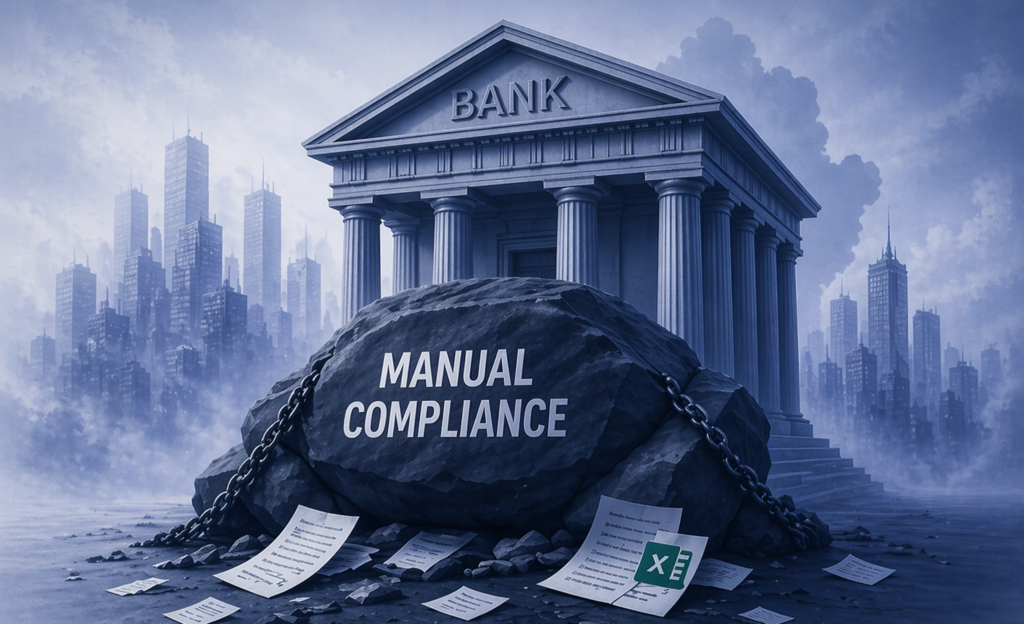
The Hidden Risk in Ethiopian Banking: Why Manual Compliance is Costing Millions
In an era of increasing regulatory scrutiny, the real risk is no longer non-compliance, it is the lack of visibility.
Across Ethiopia’s banking sector, compliance has become a high-stakes function. With tightening oversight from the National Bank of Ethiopia, banks are facing growing pressure to adhere strictly to regulatory directives or risk significant financial penalties.
Yet beneath the surface of this regulatory environment lies a less visible, but far more dangerous issue: the way compliance is managed.
For many banks, compliance is still largely manual driven by spreadsheets, emails, and fragmented reporting processes. While this may appear manageable on the surface, it introduces a level of operational risk that is both underestimated and increasingly costly.
The Illusion of Control
Manual compliance processes often create a false sense of security. Tasks are assigned. Reports are submitted. Audits are conducted. On paper, everything appears to be in order. But in reality, these processes are:
- Delayed – Information is collected periodically, not in real time
- Fragmented – Data exists across multiple systems and teams
- Error-prone – Human intervention increases the likelihood of mistakes
- Difficult to verify – Tracking accountability is complex.
In such an environment, compliance becomes reactive rather than proactive. Issues are identified only after they occur—often when it is too late to avoid penalties.
When Accountability Meets Limited Visibility
Most banks in Ethiopia are not lacking in governance structure. In fact, they typically operate under well-defined frameworks where:
- The Board of Directors holds ultimate responsibility for risk and compliance
- Specialized Board Committees oversee risk and regulatory adherenc
- Executive Management, including Chief Risk Officers and compliance leaders, manage day-to-day execution
This model is designed to ensure independence, accountability, and strong oversight at the highest level. However, its effectiveness depends entirely on one critical factor:
The quality, timeliness, and transparency of information flowing from operations to the Board.
And this is where the gap emerges. Despite having the right structures in place, many banks still rely on:
- Manually compiled reports
- Periodic updates instead of continuous monitoring
- Disconnected data sources across departments
As a result:
Boards remain fully accountable for compliance and risk but without real-time visibility into them.
The Cost of Not Knowing
In a highly regulated environment, the consequences of this visibility gap are significant.
Penalties from the National Bank of Ethiopia are not merely symbolic—they are financial, reputational, and strategic. But beyond the immediate cost of fines, there are deeper implications:
Delayed decision-making due to lack of timely insights
Increased exposure to regulatory breaches
Reduced confidence at the Board level
Operational inefficiencies across compliance functions
Ultimately, the issue is not that banks lack governance or intent. It is that their systems are not designed to support the level of visibility now required
A Systemic Challenge, Not a Human One
As directives evolve and expectations increase, manual processes simply cannot scale.
The result is a system where:
Compliance is effort-intensive but not fully reliable
Risk is monitored, but not continuously understood
Oversight exists, but without clarity or immediacy
Rethinking Compliance in a High-Stakes Environment
Periodic reporting → Continuous monitoring
Fragmented data → Centralized visibility
Manual tracking → Automated control systems
More importantly, it requires enabling true Board-level visibility—not just summarized reporting. Because in today’s environment, compliance is no longer just a function. It is a strategic capability.
From Obligation to Visibility
The future of banking in Ethiopia will not be defined by who complies, but by who can see, understand, and act on compliance in real time. Institutions that invest in visibility will:
Anticipate regulatory risks before they materialize
Make faster, more informed decisions
Strengthen trust with regulators
Reduce the financial and operational burden of compliance
Those that do not will remain in a reactive cycle managing consequences instead of preventing them.
A New Standard for Compliance
Integrated risk and compliance management
Real-time dashboards for Boards and executives
Automated tracking of regulatory obligations
End-to-end visibility across the organization
Solutions like Gibe Compliance Management Solution (GibeCMS) are designed with this exact challenge in mind helping institutions transition from manual, fragmented processes to unified, intelligent compliance ecosystems.
Final Thought
The real question is:
Do they truly know that they are?
Because in modern banking, the difference between compliance and penalty is no longer effort, It is visibility.